
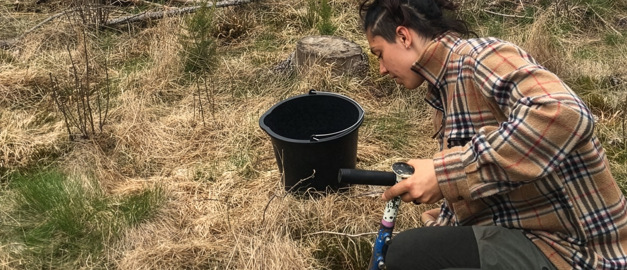
Stephanie Casey doing field work in the project.
SGU-funded research provides answers on treating DDT with fungi
Since 2021, the Geological Survey of Sweden (SGU) has been working together with SLU and Sveaskog in a dedicated research effort aimed at investigating whether DDT contamination in surface soils can be degraded using fungi. The project was carried out in the form of a doctoral position at SLU and has now resulted in the thesis “DDT in historically contaminated soil from Swedish forest nurseries – treatment with white-rot fungi.”
On April 29, Stephanie Casey at SLU defended their thesis, which in English is titled “DDT in aged, contaminated soils from Swedish forest nurseries – treatment with white-rot fungi,” in order to obtain their doctoral degree.
At many of the forest nurseries that were previously managed by the state, there is residual contamination in the soil, primarily from the pesticide and insecticide DDT. SGU has co-funded the doctoral position at SLU together with Sveaskog, which has resulted in several important insights into the effectiveness of white-rot fungi for the treatment of DDT contamination in soil.
– Investigations show that white-rot fungi can be used to break down DDT and its degradation products that have been present in the soil for a long time, but that there are major challenges in applying the method across larger and variable environments, says Stephanie Casey, PhD, author of the report
Enzymes secreted by the fungi to break down the wood component lignin were in several cases able to degrade DDT in soil collected from a contaminated forest nursery in laboratory experiments. However, in larger-scale experiments no effect was observed. It was clear that the challenge is to get the fungi, which often prefer to grow on trees, to establish themselves in soil and, there, secrete enough enzymes to break down DDT. In a bench-scale experiment, a method for soil washing using surfactants was instead tested, where added fungi were able to degrade DDT in the liquid phase. The soil washing worked well, but the method is primarily suitable for smaller areas with higher concentrations and not for large cultivation fields with shallow contamination. There, an in-situ remediation solution in the soil would be more appropriate.
The doctoral position has been part of several parallel research projects where the goal is to develop alternative remediation methods to excavation at former forest nurseries. Stephanie Casey has also contributed to developing a method that provides a better understanding of how bioavailable DDT is to soil organisms at forest nurseries. The method used is a leaching test called POM, where the concentration of DDT in water-filled pores in the soil (pore water) is determined. In this work, soil from nine forest nurseries was collected for a comparative study between two different laboratories to test the method. The results showed good correlation between the laboratories for the POM method, and it was also possible to demonstrate a good correlation between pore water concentration and uptake of DDT in earthworms.
The conclusion is therefore that the POM method can be used to provide a measure of how available the DDT contamination is to organisms living in the soil. The POM method can also be used to monitor how the binding of DDT in the soil increases if biochar is added to the soil, which SGU plans to test in a larger pilot study at a former forest nursery.
SLU has applied for and received continued funding from a foundation to build further on Stephanie Casey’s work by conducting laboratory experiments with oyster mushrooms (Pleurotus ostreatus) and attempting to maintain enzyme activity over a longer period. SGU will, together with SLU, review the possibilities of testing the method on a larger scale if the results appear promising.
Read the full report here: DDT in aged, contaminated soils from Swedish forest nurseries - treatment with white-rot fungi
DDT
DDT was used for insect control on a large scale during the 1950s–1970s, particularly in agriculture and forestry. Although the substance was banned in Sweden already in the 1970s, high levels of DDT and its degradation products still remain in contaminated soil. SGU has investigated around 40 former state forest nurseries, covering a total of approximately 700 hectares, and DDT is almost always found where operations took place during the period when DDT was allowed to be used. Forest nurseries are operations that often require extensive land areas. It is therefore likely that the total contaminated area in Sweden is significant. Many of these sites are, in addition to the contamination, high-quality agricultural land.
Last reviewed 2026-06-03