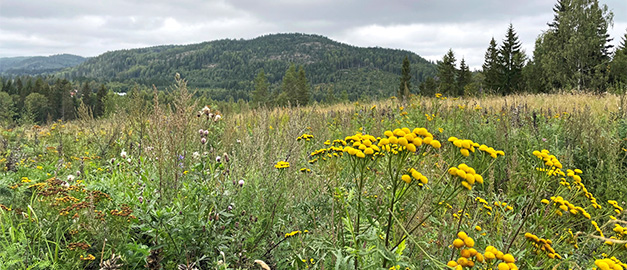
Mapping area in Ullånger.
Photo: Martiya Sadeghi, SGU.
Ancient zircons provide clues to geological evolution and future raw materials
New insights into the origin and evolution of the bedrock in Västernorrland nearly two billion years ago are improving our understanding of where critical metals and minerals may be found. In a study by the Geological Survey of Sweden (SGU), analyses of zircon crystals provide knowledge that is important for both ongoing mapping and future exploration.
As part of SGU’s 2021–2027 mapping programme, twelve samples of metasedimentary rocks were collected from Västernorrland County and neighbouring areas. The aim was to investigate the original sources of the sediments and improve our understanding of the geological development of the Bothnian Basin.
Ten of the twelve samples contained zircons suitable for dating. Approximately 1,115 analyses were carried out using the U–Pb dating method at the Geological Survey of Denmark and Greenland (GEUS).
—The analyses reveal zircon ages ranging from approximately 1.67 to 3.62 billion years. These exceptionally ancient crystals demonstrate that material derived from very old continental crust contributed to the sediments that were eventually transformed into the rocks found in the region today, says Martiya Sadeghi, senior geologist and project manager.
Overall, the samples show broadly similar zircon age patterns, suggesting that sediments across much of the study area were derived from comparable sources. However, some regional differences are also evident.
The highest proportion of Archaean zircons – those older than approximately 2.5 billion years – is generally found in the southern part of the study area, extending towards the Ostrobothnia Basin in Finland. This suggests that much of the older material may have originated from the central part of the Svecofennian depositional basin, known as the Bothnian Basin.
Kattviken, however, displays a distinct zircon age signature and a higher proportion of Archaean grains than several other investigated areas. This may indicate a different source of sedimentary material. Further provenance studies are needed to clarify the origin of these differences.
—The study provides a more detailed picture of how sedimentary and volcanic rocks formed and interacted during the early development of the Svecofennian bedrock. The results also help improve our understanding of regional geological relationships between central Sweden and Finland, says Martiya Sadeghi.
This knowledge supports SGU’s continued bedrock mapping and contributes to a better understanding of the geological processes that shaped regions where critical metals and minerals may occur. By combining geochronological analyses with geological mapping, SGU continues to build a more detailed picture of Sweden’s bedrock and its evolution throughout Earth’s history.
Read the report Detrital zircon ages of metasedimentary rocks in Västernorrland County
Last reviewed 2026-11-05