Unique 3D models reveal potential for additional ore in Riddarhyttan
With a new series of geological 3D models of the Riddarhyttan ore field, the Geological Survey of Sweden (SGU) shows that there is potential to discover new ore deposits in the area. The region is well known for its iron and copper deposits but also contains cobalt, molybdenum and rare earth elements.
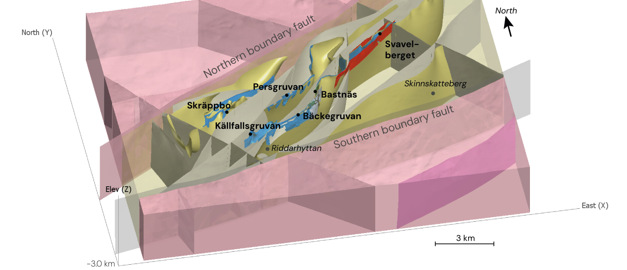
In a new report, SGU presents for the first time regional and local geological 3D models of the Riddarhyttan ore field in Bergslagen. The area includes the historical mines Bäckegruvan, Östergruvan, Stora Bastnäsgruvan, Källfallsgruvan and Persgruvan. In addition to iron, copper and gold, these mineralisations also contain metals such as cobalt, molybdenum and REE – raw materials classified as critical by the EU.
– Many operators have been active here since the 1400s to extract ore. The last mine closed in 1979, but exploration has never stopped. For the first time, we have now used all available data from previous investigations and combined maps, drill cores, geophysics and geochemistry to create 3D geological models, says senior geologist Stefan Luth.
The new 3D models are based on drill‑hole data, new structural measurements, and geophysical and geological information from exploration companies and SGU. By combining these datasets, SGU has been able to improve the existing geological map from the 1980s and create detailed models of the ore bodies. The work also shows which volumes that have been mined out and which may be remaining resources.
In total, more than 336 drill holes, with a combined length of over 43 kilometres, have been processed and incorporated into the model. The models present an interpreted view of the mineralisations, the surrounding bedrock and structures down to approximately 500 metres depth. The overarching regional model extends to 3.0 kilometres depth and is based solely on structural geological concepts at depth.
– Our conclusion is that the Riddarhyttan area is a major shear zone, or high‑strain belt, where a thick mineralised horizon has been folded multiple times. Understanding the structural deformation patterns of the area in three dimensions makes it much easier to predict where certain ore deposits may be found, says Stefan Luth.
The models and the report aim to improve understanding of the ore field’s geological architecture and to provide a coherent framwork of the various mineralisations. The results include updated and new information that can support mineral exploration, infrastructure or other decision-making projects in the region.
The models and underlying data are available at www.sgu.se.
Read the full report here:
3D geological modelling of the Riddarhyttan Ore Field (Fe-Cu-Au-Co-Mo-REE), SGU-rapport 2026:01
Last reviewed 2026-03-27