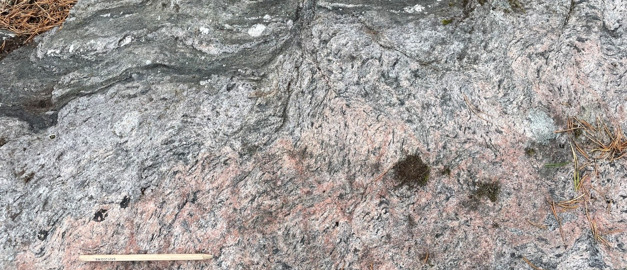
A vein of biotite and fluorapatite of Olserum-type within a strongly deformed and altered granite from a newly discovered mineralisation in 2025
Photo Stefan Andersson
New occurrences with critical raw materials found during mapping in Småland
The aim of the mapping project SGU is conducting in northeastern Småland and southeastern Östergötland is to investigate and sample the bedrock with a focus on occurrences of critical and strategic raw materials, and to improve our understanding of when and how these formed. The investigations under 2025 have discovered additional occurrences with critical raw materials.
The project is divided into three subareas: Skrikerum, Västervik and Åtvidaberg. The investigations in the Skrikerum subarea began in 2023, and fieldwork was completed in 2024. The results are now being processed and will be published in an SGU report, preliminary scheduled for spring 2026. All collected information is continuously made available through SGU’s data products.
The fieldwork in the Västervik subarea, which started in spring 2024, continued during 2025 with supplementary sampling of mineral occurrences and, above all, extensive bedrock mapping. Between May and September, bedrock observations were carried out at 1,302 locations. In addition, 78 samples were collected for geochemical analysis, 172 for petrophysical measurements, and five for radiometric age determination. Geophysical measurements (magnetic susceptibility and gamma spectrometry) were undertaken at 130 sites, and ground-based magnetic surveys were carried out to investigate anomalies previously identified in the airborne data. New gravity measurements were also made, more than doubling the number of measurement points in the area. Investigations will continue for a couple of more years.
The investigations during 2025 have resulted in several interesting findings. Notably, rare earth element (REE) mineralisations have been identified at several new sites. Smaller occurrences of the same type found at Olserum have been discovered up to ten kilometres northwest of the main deposit. Moreover, new and more representative samples from the Obälen mineralisation, which in 2024 was shown to contain high concentrations of rare earth elements, have confirmed these elevated levels. In a former mining area north of Blankaholm, previously mined for iron, new analyses have also shown slightly elevated concentrations of REEs.
Different copper mineralisations have also been sampled. Analyses show elevated concentrations of several strategic and critical metals, including copper, cobalt, nickel, tungsten, chromium and gold. At a small copper prospect near Lake Ommen, elevated levels of REEs have also been detected.
– The fact that we now have identified several new occurrences of rare earth elements, in several cases of the so-called Olserum type, demonstrates that the mineralising systems have a greater regional extent than previously thought. This indicates considerable potential for further discoveries of occurrences with rare earth elements or other critical or strategic metals in the investigated area, says Stefan Andersson, state geologist.
The Åtvidaberg subarea remains in the planning stage, and work there will begin no earlier than 2027. As is the case for the other subprojects, the aim will be to investigate the known mineral occurrences and the surrounding bedrock with a focus on critical and strategic raw materials.
Last reviewed 2026-02-18